
Magnetically controlled slippery micropropellers for targeted drug delivery through the vitreous humour of the eye
Medizin
Ref.-Nr.: 0105-5350-FG
Background
Delivering therapeutic agents to the posterior segment of the eye remains a significant challenge in ophthalmology. Diseases such as age-related macular degeneration, diabetic retinopathy and diabetic macular oedema may require treatment of structures close to the retina. Conventional intravitreal injection delivers therapeutic substances into the vitreous humour, but their subsequent distribution largely depends on passive diffusion. This creates several limitations:
- Slow distribution of therapeutic agents through the vitreous humour.
- Limited control over the final location of injected particles.
- Potential loss of drug activity during prolonged transport.
- Difficulty transporting larger particles through the collagen–hyaluronan network.
- Challenges in achieving localized drug delivery while minimizing exposure of surrounding tissues.
The vitreous humour is a complex viscoelastic medium. Its collagen network can obstruct the movement of conventional microparticles and microrobots. The invented technology addresses this problem by combining active magnetic propulsion with a surface that minimizes adhesion to the surrounding biological network.
Technology
The operational principle comprises four stages:
- Administration: Micropropellers are introduced into the vitreous humour, for example by intravitreal injection.
- Magnetic actuation: An externally applied rotating magnetic field causes the helical particles to rotate and propel themselves.
- Controlled navigation: The magnetic field direction and frequency can be adjusted to influence the movement and trajectory of the particles.
- Imaging and localization: Optical coherence tomography or other suitable imaging methods can be used to observe particle movement and support targeted positioning.
The technology also relates to the potential integration of therapeutic or diagnostic agents with the particles, enabling future drug-delivery and image-guided treatment concepts.
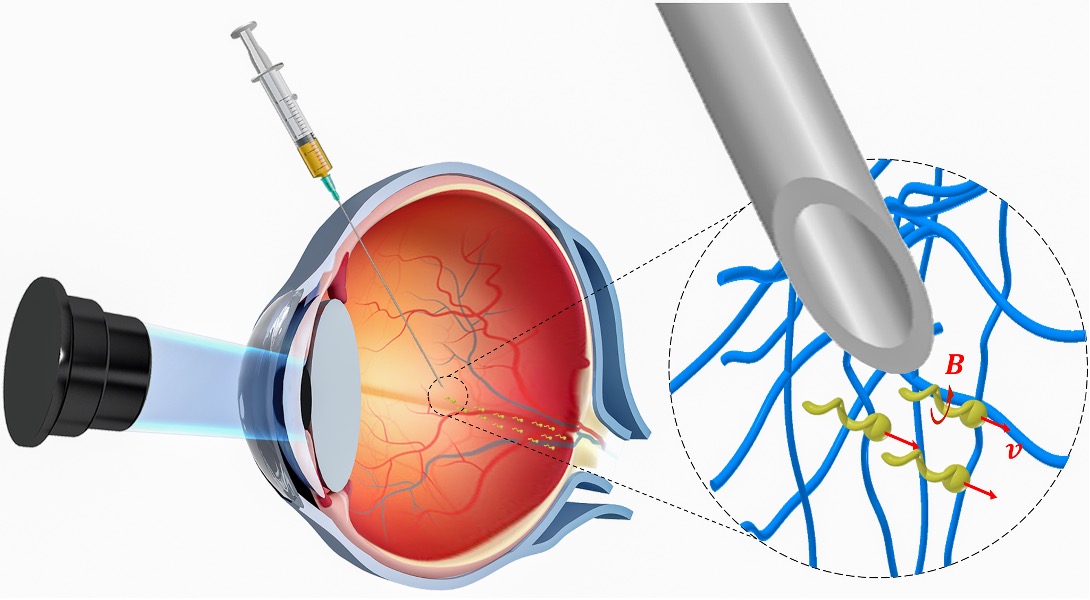
Experiments using porcine vitreous humour and intact ex vivo porcine eyes show that the slippery micropropellers (2 µm in length) realized the controllable massive movements to the retina in 30 mins, while exerting the travelling distance of above 1 cm.
Innovative Aspects
- Slippery liquid-infused surface: A lubricating coating reduces adhesion between the propellers and biological structures, facilitating movement through collagen-rich and other complex media.
- Active magnetic propulsion: Externally controlled magnetic fields drive the particles, reducing reliance on passive diffusion.
- Helical micropropeller geometry: The geometry converts rotational motion into translational movement.
- Navigation through viscoelastic environments: The technology was developed specifically to overcome the mechanical resistance and adhesion effects encountered in biological tissues and fluids.
- Image-guided operation: The demonstrated approach combines magnetic actuation with OCT-based observation of particle distribution.
- Adaptable particle functionality: The patent describes possible use with therapeutic agents, imaging agents and functional coatings.
Potential Applications
- Targeted ophthalmic drug delivery
- Image-guided microrobotic therapies
- Medical microrobotics and precision transport
- Functionalized diagnostic and therapeutic particles
- Plasmonics and optical sensing
- Catalysis and functional nanomaterials
Patent Information
EP3672540A1, CA3073465C, JP7160921B2
PDF Download
- Ref.-Nr.: 0105-5350-FG (2,2 MiB)
Kontaktperson

Patent- & Lizenzmanager
Dr. Franz Gadelmeier
Diplom-Physiker
+49 171 656 9140
gadelmeier@max-planck-innovation.de